
USPTO Says Wands Still Controls Enablement Analysis Post-Amgen
Contributed by Knobbe Martens. Originally published on Patexia; republished here as part of the LexDana archive.
Written by: Rhett D. Ramsey & Eric Furman, Ph.D.
On January 9, 2024, the USPTO published guidelines for its patent examiners when evaluating compliance with the enablement requirement in light of the U.S. Supreme Court’s recent decision in Amgen Inc. et al. v. Sanofi et al., 143 S. Ct. 1243 (2023). In Amgen, the Supreme Court unanimously held that claims drawn to a genus of monoclonal antibodies, which were functionally claimed, were invalid due to a lack of enablement. Notably, the Supreme Court did not expressly cite the Wands factors in analyzing whether the specification at issue in Amgen enabled the claims, but the recently published USPTO guidelines underscore that “USPTO personnel will continue to use the In re Wands factors to ascertain whether the amount of experimentation required to enable the full scope of the claimed invention is reasonable.”
In re Wands, 858 F.2d 731, 737 (Fed. Cir. 1988) set forth eight factors to consider when evaluating whether a specification meets the enablement requirement: (A) the breadth of the claims, (B) the nature of the invention, (C) the state of the prior art, (D) the level of one of ordinary skill, (E) the level of predictability in the art, (F) the amount of direction provided by the inventor, (G) the existence of working examples, and (H) the quantity of experimentation needed to make and use the invention based on the content of the disclosure. (MPEP 2164.01(a)). The USPTO characterized its guidelines as simply incorporating the guidance from the Amgen decision and several post-Amgen enablement decisions and emphasized that “[t]he Wands factors are probative of the essential inquiry in determining whether one must engage in more than a reasonable amount of experimentation….”
Broadening the application of the Wands factors beyond antibodies, the USPTO stated that, although Amgen involved a unique technology of antibodies, “there is no reason to treat the decision as limited to antibodies or biotechnology; the principles set forth in this decision regarding the enablement requirement apply to all fields of technology.” Accordingly, the enablement determination before the USPTO remains focused on whether the amount of experimentation required by the specification is “reasonable.”
Editor: Brenden S. Gingrich
More insights
Does the Uspto Issue Secret Patents on Aerospace Innovations
Written by : Tom Cowan Key Takeaways : Despite periodic mentions by aerospace innovators of “secret patents,” this author is not aware of any evidence of such patents. There may be confusion with “Secrecy Orders,” which apply to…
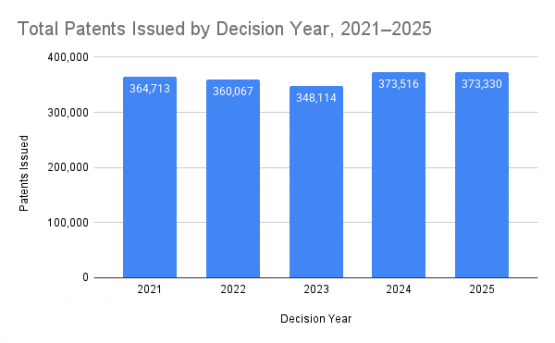
Patexia Patent Insight 20: Patent Issuance Levels Hold Steady Through 2025
Raw numbers often say more than commentary. In patent prosecution, issuance data provides one of the clearest signals of how much innovative activity is actually making its way through the system. Unlike filings, which can reflect short-term strategy…
Life Science Considerations on the Uspto S New Guidelines for Ai Assisted Inventorship
Written by : Robert J. Hilton, Ph.D. and Susan M. Janicki, Ph.D. On November 26, 2025, the United States Patent and Trademark Office (USPTO) issued revised guidelines for determining inventorship of AI-assisted inventions, [1] which is a significant…