
University of Minnesota Sues Gilead Sciences for Infringement of Hepatitis C Patents
Contributed by Knobbe Martens. Originally published on Patexia; republished here as part of the LexDana archive.
On August 29, 2016, the Regents of the University of Minnesota (“the University”) filed suit against Gilead Sciences (“Gilead”) for patent infringement in the District Court for the District of Minnesota. According to the complaint, the University alleges that Gilead’s sale of drugs containing the nucleotide analog sofosbuvir infringes their U.S. Patent No. 8,815,830 (the ’830 patent).
Gilead Sciences is a biopharmaceutical company that sells antiviral drugs for the treatment of HIV, hepatitis B (HBV), hepatitis C (HCV), and influenza. Gilead’s HCV drugs generated more than $19 billion in sales in 2015, and accounted for more than 60% of Gilead’s revenue. Gilead markets its HCV drugs as Sovaldi®, Harvoni®, and Epclusa®, each of which contains the nucleotide analog, sofosbuvir. Sofosbuvir is used for the treatment of HCV infections, and has a reduced therapeutic duration as compared to other treatments. Sofosbuvir is an RNA-dependent RNA viral polymerase inhibitor, and thereby inhibits RNA-dependent RNA viral replication.
The ’830 patent was issued on August 24, 2014 and listed University professor Carston Wagner as the inventor. The ‘830 patent claims specific compounds and methods for treating a viral infection. In the complaint, the University alleges that Gilead infringes literally, and under the doctrine of equivalents, at least claims 1-9 and 11-12 of the ’830 patent by selling Sovaldi®, Harvoni® and Epclusa®. The University also alleges that Gilead infringes claims 13-21 and 23-28 by actively and intentionally inducing others to infringe.
In response to the complaint, a Gilead spokesperson stated that the company strongly believes that it has the sole right to commercialize (Sovaldi®) in the U.S. and that the University of Minnesota’s patent is invalid and is not infringed by the sale of Gilead’s medicines for chronic hepatitis C.
More insights
Structuring Solar IP Claims for Leverage: How System Claims and Induced or Contributory Infringement Can Expand Enforcement Options
Written by: Tyler S. Cox Key Takeaways: Nextpower’s mix of apparatus and system claims illustrates how claim strategy can expand enforcement flexibility. Additionally, carefully drafting patent claims can expand the scope of protection of the claim…
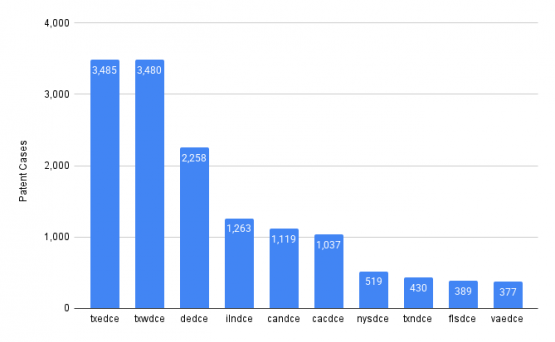
Patexia Insight 256: Patent Litigation Remains Concentrated in Key U.S. District Courts
U.S. District Court patent litigation continues to be one of the most consequential and data-rich arenas in intellectual property enforcement. Between July 1, 2020, and June 30, 2025, 18,352 patent cases were filed across federal courts, involving tens of…
Litigation Finance Tax Dropped From Trump S Big Beautiful Bill
In a major development for the billion dollar litigation finance industry, a tax provision targeting litigation funders has been removed from President Trump’s sweeping tax and spending legislation, dubbed the “Big, Beautiful Bill”,…