
Ucb v Yeda R D Co No Safe Harbor for Unamended Claims
Contributed by Schwegman Lundberg & Woessner. Originally published on Patexia; republished here as part of the LexDana archive.
UCB sued Yeda for a DJ of non-infringement of US Patent No. 6,090,923 [Appeal No. 2015-1957 (Fed. Cir. September 8, 2016)].The main claim in question was directed to “A monoclonal antibody which specifically binds a human cytotoxin [having X properties].” The specification only disclosed murine Mabs (the priority document was filed in 1984). During prosecution, Yeda had limited the claims to murine Mabs, and then later removed that limitation.
The Examiner rejected that claim as non-enabled as to the different species that were encompassed. Yeda argued that the claim should be read to encompass humanized and chimeric Mabs and put in a declaration that other species could be used to obtain the Mabs. The Examiner withdrew the non-enablement rejection but rejected claims that recited chimeric Mabs as unsupported new matter.
Yeda cancelled the chimeric claim. The claim that became claim 1 had never recited chimeric antibodies and had not been amended during prosecution “with respect to that aspect.” Yeda then argued that the claim should be read to encompass chimeric and humanized antibodies.The Fed. Cir. found that both the specification and the prosecution history “weighs towards a construction of ‘monoclonal antibodies’ which does not include chimeric or humanized antibodies.”
The Fed. Cir. agreed with the district court that “Yeda’s unsuccessful attempt to claim chimeras in the pending application, with acquiescence in the examiner’s rejection on the ground of new matter…prohibited now obtaining a claim construction that chimeric antibodies, or equivalents thereof, are described in the specification and included in the claims.…the general rule is that a patent applicant cannot later obtain scope that was requested during prosecution, rejected by the Examiner, and then withdrawn by the applicant….Yeda is estopped from including chimeric and humanized antibodies within the scope of the monoclonal antibodies claimed in the ‘923 Patent.”
Interestingly, would the result have been different if Yeda had not made a “request” for such “scope” during prosecution? Yeda obtained a claim to “monoclonal antibodies” that literally encompassed chimeric and humanized antibodies, and had presented evidence that such antibodies were known when the priority document was filed. However, even if enabled and encompassed by the claims, the undescribed humanized/chimeric antibodies would surely have failed to meet the written description requirement post-Ariad. So perhaps Yeda has the cold comfort of at least keeping valid, albeit narrow, claims. Read the full opinion here.
This article was originally published on Patents4Life.com.
Patents4Life is sponsored by Schwegman Lundberg & Woessner, P.A.
More insights
Structuring Solar IP Claims for Leverage: How System Claims and Induced or Contributory Infringement Can Expand Enforcement Options
Written by: Tyler S. Cox Key Takeaways: Nextpower’s mix of apparatus and system claims illustrates how claim strategy can expand enforcement flexibility. Additionally, carefully drafting patent claims can expand the scope of protection of the claim…
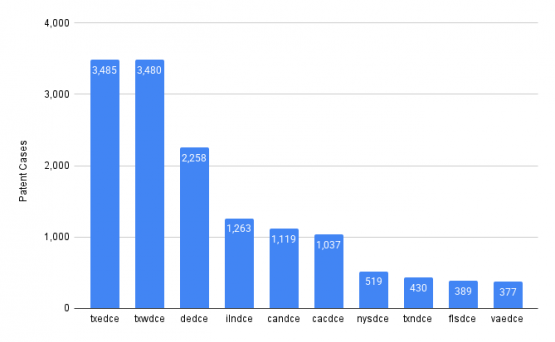
Patexia Insight 256: Patent Litigation Remains Concentrated in Key U.S. District Courts
U.S. District Court patent litigation continues to be one of the most consequential and data-rich arenas in intellectual property enforcement. Between July 1, 2020, and June 30, 2025, 18,352 patent cases were filed across federal courts, involving tens of…

Litigation Finance Tax Dropped From Trump S Big Beautiful Bill
In a major development for the billion dollar litigation finance industry, a tax provision targeting litigation funders has been removed from President Trump’s sweeping tax and spending legislation, dubbed the “Big, Beautiful Bill”,…