
So you think you know patent law, part 2
Contributed by swcp.com. Originally published on Patexia; republished here as part of the LexDana archive.
This is the middle article of a set of three on the effect of the America Invents Act. The first article discussed the First-Inventor-to-File system changes, the status of an Internet "publication" and the new "micro-entity" for individual inventors and small start-ups. I'll continue here with the changed status of the best mode in a patent specification, what can't be patented and virtual marking.
The AIA changes to the best mode requirements have a somewhat different effect than would appear at first glance. There is no change in the requirement to disclose the best mode of practice of the claimed invention in the application. If, during examination, the examiner determines that “the best mode contemplated by the inventor of carrying out his invention” is not included within the specification, he will reject the application based on a violation of 35 U.S.C. 112, just as is done now.
The change made by the AIA appears in the presumption of validity of an issued patent in 35 U.S.C. 282. Every claim in an issued patent is presumed to be valid. Should an entity infringe on an issued patent, before the AIA, the validity of the patent could be challenged “for failure to comply with any requirement of sections 112 or 251 of this title.” This would include not disclosing the best mode.
Now, however, the same section states, “for failure to comply with (A) any requirement of section 112 . . . except failure to disclose the best mode.” It is extraordinarily difficult to determine what the inventor was contemplating as best mode at the time of filing, and it would appear that this amendment was inserted simply to simplify post-grant Office and district court procedures.
No amendment to 35 U.S.C. 101 was made by the AIA, and yet certain inventions have been ruled out or limited as to patentability. The most noted change (Section 14 of the AIA) is to declare any strategy for reducing, avoiding or deferring tax liability as insufficient to differentiate a claimed invention from the prior art. Methods for tax preparation or financial management are explicitly removed from this declaration. The tax strategies that are no longer available to provide patentable distinction would arguably be added mainly to business method patents. Despite this, Section 14 includes a Rule of Construction that specifically states that no implication is intended to suggest that business methods are either patentable or valid. This question was not explicitly addressed by the AIA.
On other topics, Section 33 of the AIA states that “no patent may issue on a claim directed to or encompassing a human organism.” At this point in time, the terms are open to a wide range of interpretations. At one extreme, everything would be patentable unless an entire human being were being claimed. At the other, procedures such as growing human teeth in vitro for transplantation or stem cell therapy to repair heart tissue might be out of bounds for patenting. Over the remainder of this decade, I’m sure that this provision will be clarified by the courts, but there may be some challenging times ahead for the biomedical industry.
The final area of modified patentability is in “covered business method patents.” This term covers a new subclass of business method patents, which claim a “method or corresponding apparatus for performing data processing or other operations used in the practice, administration, or management of a financial product or service.” This subclass does not include patents for technological inventions. Covered business method patents issued before the AIA was passed and signed will be subject to post-grant review (a new approach to challenge a patent — tune in next week) for the next 8 years. Such review can be used only by a party charged with infringement of such a patent. The author of this provision of the AIA was New York Senator Charles Schumer, and it appears to be directed toward supplying the banking industry a defensive tool against holding companies accused by some of trollish litigation practices aimed at some modern banking procedures.
I’ll close for this week with an odd AIA provision. The act’s 35 U.S.C. 287(a) states that no damages shall be recovered from an infringing party if there was no public notice (such as a mark containing the patent number) either on the patented device or on the packaging thereof, unless the patent owner had proof that the infringer was notified of the infringement and continued to infringe thereafter. The AIA amended this subparagraph to read as follows:
Patentees . . . offering for sale . . . any patented article . . . may give notice to the public that the same is patented, either by fixing thereon the word “patent” or the abbreviation “pat.”, together with the number of the patent, or by fixing thereon the word “patent” or the abbreviation “pat.” together with an address of a posting on the Internet . . . that associates the patented article with the number of the patent, or when . . .
Thus, if a patented article comprises a pointer to an Internet site where the item is associated with one or more patent numbers (virtual marking), the public is assumed to have been given notice that the specific article on sale is protected by patent. It is not clear that this makes a great deal of difference, save that the patent protection of an article for sale can be kept current as it is protected by newly issued patents, or when patents are found to be invalid.
In the final blog of this series, we will look at the new processes for prosecuting and challenging a patent.
More insights
Does the Uspto Issue Secret Patents on Aerospace Innovations
Written by : Tom Cowan Key Takeaways : Despite periodic mentions by aerospace innovators of “secret patents,” this author is not aware of any evidence of such patents. There may be confusion with “Secrecy Orders,” which apply to…
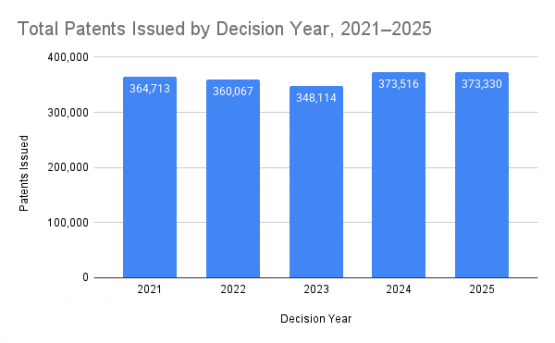
Patexia Patent Insight 20: Patent Issuance Levels Hold Steady Through 2025
Raw numbers often say more than commentary. In patent prosecution, issuance data provides one of the clearest signals of how much innovative activity is actually making its way through the system. Unlike filings, which can reflect short-term strategy…
Life Science Considerations on the Uspto S New Guidelines for Ai Assisted Inventorship
Written by : Robert J. Hilton, Ph.D. and Susan M. Janicki, Ph.D. On November 26, 2025, the United States Patent and Trademark Office (USPTO) issued revised guidelines for determining inventorship of AI-assisted inventions, [1] which is a significant…