
Reckitt Benckiser v. Aurobindo: Make Sure Your Expert Helps Your Case
Contributed by Oblon. Originally published on Patexia; republished here as part of the LexDana archive.
Last week, the Delaware district court granted Aurobindo’s motion for summary judgment of non-infringement of Reckitt’s patents directed to a “modified release drug product” containing a sustained-release formulation of guaifenesin and an immediate-release formulation of guaifenesin. The court found Reckitt had not produced sufficient evidence that two different formulations existed in Aurobindo’s product, and that summary adjudication of non-infringement was appropriate.
In addition to moving for summary judgment of non-infringement, Aurobindo moved to exclude testimony from Reckitt’s expert under Daubert. The court did not exclude the testimony because the expert was technically qualified. However, the court did find that Reckitt did not provide any evidence (including evidence through the expert) concerning the physical structure of Aurobindo’s products.
Reckitt based its infringement theory on bioequivalence of Aurobindo’s product (as described in the ANDA) – Reckitt argued that because Aurobindo’s product was bioequivalent to Reckitt’s product, one could infer that the structures were similar. The court dismissed Reckitt’s theory as well as the expert’s opinion supporting this theory. The court noted that “bioequivalence is not the test for infringement.”
So what went wrong for Reckitt?
According to the court, the expert did not conduct an element-by-element infringement analysis, opting instead to rely on inferences arising from bioequivalence.
The expert also did not address the disclosure and examples in Reckitt’s patents relating to “single layer,” sustained-release products of guaifenesin which exhibited immediate release as well. The court noted that Aurobindo’s product, like this disclosure/examples in Reckitt’s patents, did not contain multiple “formulations” yet still provided both immediate- and sustained-release of guaifenesin. So the patents themselves rebutted Reckitt’s argument that bioequivalence alone was sufficient to determine structure and, thus, infringement. But neither Reckitt nor its expert addressed this disclosure in the patents.
At the end of the day, it appears that Aurobindo’s “single-layer” product related to disclosed-but-not claimed subject matter in Reckitt’s patents, and that Reckitt and its expert never provided evidence demonstrating how Reckitt’s claims cover such subject matter. So it should come as no surprise that the court granted summary judgment of non-infringement.
More insights
Structuring Solar IP Claims for Leverage: How System Claims and Induced or Contributory Infringement Can Expand Enforcement Options
Written by: Tyler S. Cox Key Takeaways: Nextpower’s mix of apparatus and system claims illustrates how claim strategy can expand enforcement flexibility. Additionally, carefully drafting patent claims can expand the scope of protection of the claim…
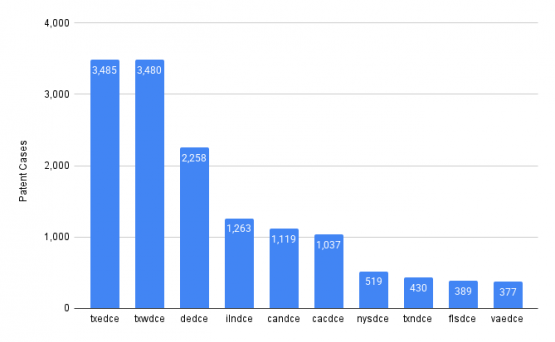
Patexia Insight 256: Patent Litigation Remains Concentrated in Key U.S. District Courts
U.S. District Court patent litigation continues to be one of the most consequential and data-rich arenas in intellectual property enforcement. Between July 1, 2020, and June 30, 2025, 18,352 patent cases were filed across federal courts, involving tens of…

Litigation Finance Tax Dropped From Trump S Big Beautiful Bill
In a major development for the billion dollar litigation finance industry, a tax provision targeting litigation funders has been removed from President Trump’s sweeping tax and spending legislation, dubbed the “Big, Beautiful Bill”,…