
Now video cameras provide second sight!
Second Sight Medical Products, Inc., a Californian company recently obtained a patent vide Patent No. 8,000,000 on a technology aimed at helping the blind see light and shapes through the use of tiny video cameras. It is concerned with a visual apparatus and a method for creation of artificial vision. In particular, the present disclosure provides an interface and method for controlling a visual prosthesis (i.e. device) implanted in an individual patient (i.e. subject) to create artificial vision.
The technology involves a video camera and a signals processor. The video camera records the images it sees and then the signals processor takes the video feed and converts it into electronic signals that mimic normal stimulation patterns for the eye.
Although this aspect is clear, it is still difficult to understand from the patent description as to how the human brain would intercept the signals received from the video camera and convert them into visual signals to perform the function of a human eye. Although it is claimed that the video camera sends a stimulating impulse to neural tissue in a subject's eye.
The invention is hinged upon the fact that a neural tissue can be artificially stimulated and activated by prosthetic devices that pass pulses of electrical current through electrodes on such a device. The passage of current causes changes in electrical potentials across visual neuronal membranes, which can initiate visual neuron action potentials, which are the means of information transfer in the nervous system. Based on this mechanism, it is possible to input information into the nervous system by coding the information as a sequence of electrical pulses which are relayed to the nervous system via the prosthetic device. In this way, it is possible to provide artificial sensations including vision.
Second Sight has 90 issued U.S. patents surrounding technology associated with sight restoration for the blind and treatment of a variety of other medical conditions,” said Robert Greenberg, president and CEO of Second Sight.
But Patent No. 8,000,000 specifically serves those who suffer blindness due to outer retinal degeneration by enhancing their visual perception.
Another interesting fact about this patent grant is that it is the 8 millionth patent granted by the USPTO, the pace of growing innovation.
Although Second Sight gets the patent, the research was at least partially paid by the U.S. Government. According to a USPTO press release, the device is currently undergoing U.S. clinical trials, and it has been approved for sale in Europe. The invention uses electrical stimulation of the retina to produce the visual perception of patterns of light.
“This kind of innovation is a driver of our nation’s economic growth and job creation,” said Under Secretary of Commerce for Intellectual Property and Director of the USPTO David Kappos. It is fitting that the 8,000,000th patent is for video processing and biomedical engineering, two fields that are rapidly advancing, important technologies in the 21st century.
Though we can’t say with much certainty whether this invention is a breakthrough of a kind since there have been few claims in the past of being able to provide vision with the aid of video camera implanted or synchronized with the brain cells[1].
More insights
Does the Uspto Issue Secret Patents on Aerospace Innovations
Written by : Tom Cowan Key Takeaways : Despite periodic mentions by aerospace innovators of “secret patents,” this author is not aware of any evidence of such patents. There may be confusion with “Secrecy Orders,” which apply to…
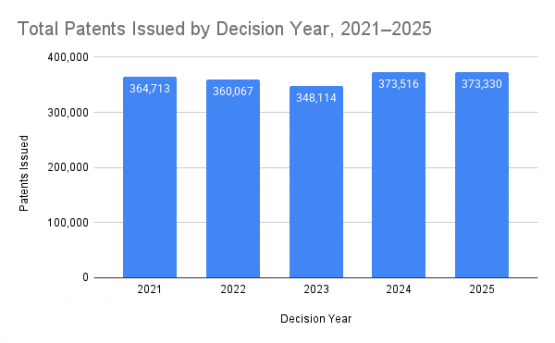
Patexia Patent Insight 20: Patent Issuance Levels Hold Steady Through 2025
Raw numbers often say more than commentary. In patent prosecution, issuance data provides one of the clearest signals of how much innovative activity is actually making its way through the system. Unlike filings, which can reflect short-term strategy…
Life Science Considerations on the Uspto S New Guidelines for Ai Assisted Inventorship
Written by : Robert J. Hilton, Ph.D. and Susan M. Janicki, Ph.D. On November 26, 2025, the United States Patent and Trademark Office (USPTO) issued revised guidelines for determining inventorship of AI-assisted inventions, [1] which is a significant…