
Novartis Loses Bid for Preliminary Injunction Against MSN Pharmaceuticals
Contributed by Knobbe Martens. Originally published on Patexia; republished here as part of the LexDana archive.
Written by: Rhett D. Ramsey & Joseph Mallon, Ph.D.
Judge Andrews of the District of Delaware recently denied Novartis’s request for a preliminary injunction against MSN Pharmaceuticals. Novartis Pharm. Corp. v. MSN Pharm. Inc., Civil Action No. 20-md-2930-RGA, Dkt. No. 1456 (D. Del. Aug. 12, 2024). Novartis had requested a preliminary injunction to block MSN Pharmaceuticals from launching a generic version of Novartis’s top-selling oral heart failure drug Entresto®.
Judge Andrews applied the traditional four-factor test for a preliminary injunction—a movant must establish that (1) the movant is likely to succeed on the merits, (2) the movant is likely to suffer irreparable harm in the absence of preliminary relief, (3) the balance of equities tips in the movant’s favor, and (4) an injunction is in the public interest.
Regarding likelihood of success on the merits, Novartis argued it was likely to succeed in showing that claim 1 of its U.S. Patent No. 11,096,918 (the ’918 patent) is valid and infringed by MSN's generic ANDA product. The ’918 patent covers the amorphous solid form of a compound ("TVS") present in Entresto®. MSN argued that its generic product contains crystalline TVS—not the claimed amorphous TVS. In this battle of the experts, Judge Andrews sided with MSN, finding that Novartis had failed to meet its burden of showing it is likely to succeed in proving MSN’s ANDA product contains amorphous TVS.
Regarding irreparable harm, Novartis offered two main arguments in support of irreparable harm. First, Novartis argued that the full extent of its losses would be difficult—if not impossible—to calculate due to “complicated and changing dynamics of the heart failure drug market.” Judge Andrews disagreed, describing the alleged losses as “standard economic analyses that can be quantified and compensated.” Second, Novartis argued that the monetary damages would likely be beyond MSN’s ability to pay. Judge Andrews again disagreed, stating, “I am confident that MSN, a large generic drugmaker with prior experience in conducting at-risk launches . . . would be sufficiently prepared to launch its generic [products] without being driven to financial ruin by possible litigation losses.” Judge Andrews therefore held that “Novartis has not shown its asserted harms cannot be remedied through monetary damages.”
Judge Andrews concluded that his “findings on the likelihood of success and irreparable harm factors call for denial of Novartis’s request for injunctive relief.” He also briefly noted that the balance of equities and public interest prongs do not support granting Novartis a preliminary injunction.
The case is part of a broader multidistrict litigation in which Novartis is trying to stop generic competition of its heart failure medication Entresto®.
Editor: Brenden S. Gingrich, Ph.D.
More insights
Structuring Solar IP Claims for Leverage: How System Claims and Induced or Contributory Infringement Can Expand Enforcement Options
Written by: Tyler S. Cox Key Takeaways: Nextpower’s mix of apparatus and system claims illustrates how claim strategy can expand enforcement flexibility. Additionally, carefully drafting patent claims can expand the scope of protection of the claim…
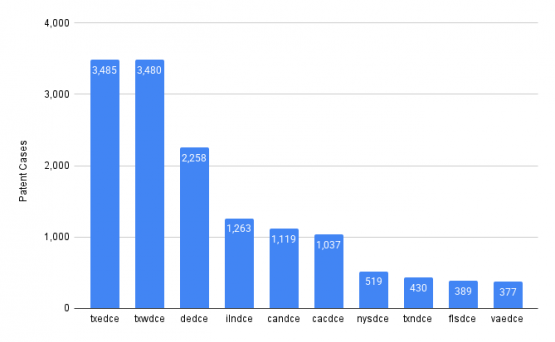
Patexia Insight 256: Patent Litigation Remains Concentrated in Key U.S. District Courts
U.S. District Court patent litigation continues to be one of the most consequential and data-rich arenas in intellectual property enforcement. Between July 1, 2020, and June 30, 2025, 18,352 patent cases were filed across federal courts, involving tens of…
Litigation Finance Tax Dropped From Trump S Big Beautiful Bill
In a major development for the billion dollar litigation finance industry, a tax provision targeting litigation funders has been removed from President Trump’s sweeping tax and spending legislation, dubbed the “Big, Beautiful Bill”,…