
The History and Evolution of Section 1498: Origins and Impact on the US Government's Use of Patented Technology

Section 1498 of the US Code is a law that allows the US government to use patented technology without the owner's permission, provided that it pays the owner reasonable compensation. The law has been in place since 1910, and its origins can be traced back to the early 19th century.
During the Civil War, the US government needed to quickly procure goods and services to support the war effort. However, the government did not have the resources to negotiate with patent owners for the use of their inventions. As a result, it began using patented technology without the owner's permission, which led to a wave of lawsuits from patent holders.
In 1910, Congress enacted the first version of § 1498, which was triggered by an infringement suit against the US government by the owner of a patent on a concrete pavement method during the Capitol renovation. The Supreme Court rejected the suit on grounds of sovereign immunity. In response, Congress enacted the Act of June 25, 1910, which provided a cause of action for "reasonable compensation" for any use of a patented invention by the US government without the owner's license or lawful right to use it. This law did not cut back on patentees' remedies against the government, as no remedy was available before due to sovereign immunity. Instead, it expanded patent protection by offering a new, albeit partial, remedy for government use. Since the law did not provide for compensation to the patent owners, it led to further litigation. In 1918, Congress amended the law to require the government to pay reasonable compensation to patent owners for the use of their technology. This helped to reduce the number of lawsuits brought against the government for patent infringement.
Section 1498 of Title 28 of the United States Code has been used in various instances throughout history. In 1996, Gargoyles Inc. lost their appeal for reasonable compensation for direct infringement of their patent for protective eyewear by the US government. In 2001, Tommy Thompson threatened to invoke section 1498 against Bayer AG when they refused to lower prices for the antibiotic Cipro during the anthrax threat. The United States Department of the Treasury used it in 2009 to "purchase software without regard to patents." In 2014, Liberty Ammunition Inc sued the US government for patent infringement of a green bullet, and the government invoked section 1498. In 2015, Senator Bernie Sanders suggested the Secretary of Veterans Affairs invoke section 1498 to break patents on direct-acting antivirals, and Yale and Harvard professors suggested the government invoke section 1498 to make high-cost therapies widely available to patients. Louisiana investigated the use of section 1498 to make Sofosbuvir, a highly effective treatment for Hepatitis C, more accessible to Medicaid hepatitis patients.
Over the years, Section 1498 has been used in a variety of cases, ranging from military equipment to healthcare products. It has also been controversial, with some arguing that it undermines property rights and discourages innovation. In recent years, there have been calls to reform Section 1498 to better balance the needs of patent owners and the public interest. Some have proposed increasing compensation to patent owners, while others have suggested limiting the government's ability to use patented technology. As technology continues to advance, it will be interesting to see how the law evolves to address new challenges and opportunities.
More insights
Does the Uspto Issue Secret Patents on Aerospace Innovations
Written by : Tom Cowan Key Takeaways : Despite periodic mentions by aerospace innovators of “secret patents,” this author is not aware of any evidence of such patents. There may be confusion with “Secrecy Orders,” which apply to…
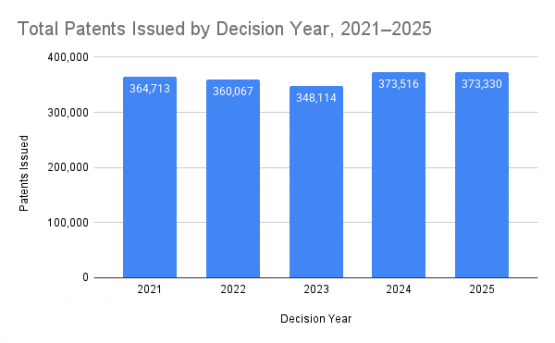
Patexia Patent Insight 20: Patent Issuance Levels Hold Steady Through 2025
Raw numbers often say more than commentary. In patent prosecution, issuance data provides one of the clearest signals of how much innovative activity is actually making its way through the system. Unlike filings, which can reflect short-term strategy…
Life Science Considerations on the Uspto S New Guidelines for Ai Assisted Inventorship
Written by : Robert J. Hilton, Ph.D. and Susan M. Janicki, Ph.D. On November 26, 2025, the United States Patent and Trademark Office (USPTO) issued revised guidelines for determining inventorship of AI-assisted inventions, [1] which is a significant…