
Divide and Conquer How Louis Vuitton S Brand Protection Strategy Might Increase the Opportunities for Brand Owners to Combat Infringement
Contributed by Knobbe Martens. Originally published on Patexia; republished here as part of the LexDana archive.
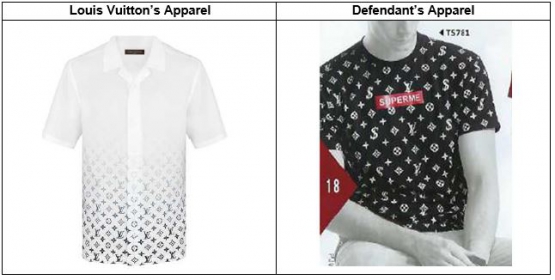
On November 7, 2018 Louis Vuitton Malletier, S.A. filed a complaint in the Southern District of New York against i-Fe Apparel, Inc., Yongun Jung, and a number of presently unknown entities and individuals (“Defendants”). Louis Vuitton alleges trademark counterfeiting, trademark infringement, false designation of origin, and trademark dilution. Louis Vuitton asserts that the defendants are willfully and intentionally infringing on several of their marks within Class 25, by selling products made of inferior materials and having poor construction, at prices well below those of authentic Louis Vuitton products. In the complaint, Louis Vuitton also claims to have invested “millions of dollars and decades of time and effort” so that consumers will recognize Louis Vuitton marks throughout the world and associate the marks with high quality, luxury goods. Examples of Louis Vuitton’s apparel depicting its registered marks, and Defendants’ allegedly infringing apparel, are shown below:
Louis Vuitton has used its Toile Monogram Design for over 120 years and has obtained nine trademark registrations which incorporate aspects of the design. This case is interesting because Louis Vuitton is not asserting infringement of a single mark, but of nine separately registered marks. The complaint separates these asserted marks into three groups: the Toile Monogram Design Trademark, comprising four separate marks; the LV Design Trademark, comprising two separate marks, and the Flower Design Trademarks, comprising three separate marks, as shown below:

Louis Vuitton’s trademark registration strategy allows Louis Vuitton to assert three counts of trademark infringement, three counts of trademark counterfeiting, and three counts of trademark dilution for each infringing article of clothing. Because it has separately registered individual elements of a complex design, it asserted one count for each category shown above. Louis Vuitton also asserted a federal false designation cause of action and several state and common law causes of action, using the separate mark groups for most of these as well.
Louis Vuitton’s strategy of separately registering the individual elements of a pattern, could entitle Louis Vuitton to greater monetary damages if the Defendants are found to infringe all the asserted marks. This brand protection strategy also gives Louis Vuitton an additional opportunity to assert its trademarks against potential infringers that make slight alterations to portions of the Toile Monogram Design Mark.
For brand owners, this case highlights the potential advantage of registering individual elements of a pattern or design.
Editor: Catherine Holland
Written by: Victoria E.Ellis & Peter Law
More insights
Structuring Solar IP Claims for Leverage: How System Claims and Induced or Contributory Infringement Can Expand Enforcement Options
Written by: Tyler S. Cox Key Takeaways: Nextpower’s mix of apparatus and system claims illustrates how claim strategy can expand enforcement flexibility. Additionally, carefully drafting patent claims can expand the scope of protection of the claim…
Patexia Insight 256: Patent Litigation Remains Concentrated in Key U.S. District Courts
U.S. District Court patent litigation continues to be one of the most consequential and data-rich arenas in intellectual property enforcement. Between July 1, 2020, and June 30, 2025, 18,352 patent cases were filed across federal courts, involving tens of…

Litigation Finance Tax Dropped From Trump S Big Beautiful Bill
In a major development for the billion dollar litigation finance industry, a tax provision targeting litigation funders has been removed from President Trump’s sweeping tax and spending legislation, dubbed the “Big, Beautiful Bill”,…