
China S New Ip Courts Up to the Challenge
As China has grown and developed it has drawn regular controversy over international intellectual property protection issues. The Office of the United States Trade Representative publishes a watch list for intellectual property rights protections internationally, and China has made the list every year since it was created.
However, as China has grown and developed, both as an international power and in terms of domestic innovation, it has become increasingly interested both in improving the reality of its IP protections, as well as its global image. In that vein, on August 31, 2014 China’s legislature approved the establishment of three specialized IP courts to be located in Beijing, Shanghai and Guangzhou.
All three courts are now in operation with Beijing launching first on November 6, 2014, followed by Guangzhou on December 16, 2014, and finally Shanghai in January 2015. Prior to the establishment of these courts, IP cases were tried in the civil court system before judges with an IP background. The highest level cases were heard by the IP tribunal of the Supreme People’s Court.
The new courts will handle civil cases relating to patents, trademarks, and computer software issues. Geographically, Beijing and Shanghai have jurisdiction over the cases in their own cities while Guangzhou has a wider reach, covering the whole Guangdong province. Cases outside of these areas will still be heard in the general court system.
Wang Chuang, the deputy presiding judge with the IP division of China’s Supreme Court spoke about the courts saying that “This will be an important revolution of the country’s judicial system to deal with IP-related cases,” It’s also “a step to promote the development of China’s emerging industries.”
Given that the courts have specific and restricted jurisdiction both in terms of subject matter and location, these new courts may not be the definitive solution to China’s IP challenges, but they are a step forward in acknowledging the problem and preparing China for a more mature IP market in the future.
More insights
Structuring Solar IP Claims for Leverage: How System Claims and Induced or Contributory Infringement Can Expand Enforcement Options
Written by: Tyler S. Cox Key Takeaways: Nextpower’s mix of apparatus and system claims illustrates how claim strategy can expand enforcement flexibility. Additionally, carefully drafting patent claims can expand the scope of protection of the claim…
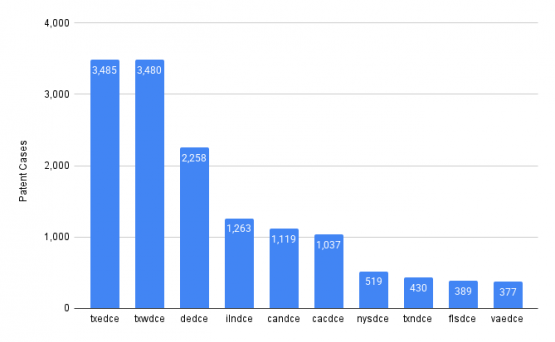
Patexia Insight 256: Patent Litigation Remains Concentrated in Key U.S. District Courts
U.S. District Court patent litigation continues to be one of the most consequential and data-rich arenas in intellectual property enforcement. Between July 1, 2020, and June 30, 2025, 18,352 patent cases were filed across federal courts, involving tens of…

Litigation Finance Tax Dropped From Trump S Big Beautiful Bill
In a major development for the billion dollar litigation finance industry, a tax provision targeting litigation funders has been removed from President Trump’s sweeping tax and spending legislation, dubbed the “Big, Beautiful Bill”,…