
Akamai v How to Induce Infringement of a Method of Treatment Claim
Contributed by Schwegman Lundberg & Woessner. Originally published on Patexia; republished here as part of the LexDana archive.
I have both been busy since the holiday season and frankly, uninspired by the case law that has appeared on the scene. Who can be enraptured by the fine points of standing when we are all speculating about whether Michelle Lee still has a job – along with a number of unfilled vacancies under her, or how sure-thing Gorsuch will rule on immigrants’ rights? (The three IP oriented decisions I have read that he generated are about as far from biotech as one can get.)
So I missed the more relevant decision, Eli Lilly v. Teva, App. No. 2015-2067 (Fed. Cir., Jan. 12, 2017).The basic standard interpreting the S. Ct. mandate to apply the standards for direct infringement to “divided infringement”, since liability for induced infringement under 271(b) must be predicated on direct infringement, which can be performed by multiple actors.
The Fed. Cir. tackled the question in the context of a Hatch-Waxman suit in which Lilly asserted that the required labelling for generic ALIMTA© proposed by the defendant induced infringement of its patent on pre-dosing with folic acid and cobalamin by the patient prior to the physicians’ administration of the anti-cancer drug Pemetrexed. The Fed. Cir. set forth the applicable rule:
“Where, as here, no single actor performs all steps of a method claim, direct infringement only occurs if ‘the acts of one are attributable to the other such that a single entity is responsible for the infringement.” [Akamai V, 797 f. 3d at 1022]
Since there was no “joint enterprise”, the court was left to define the conditions of directing or controlling. The court found that directing or controlling others’ performance includes an actor (1) “‘conditions participation in an activity or receipt of a benefit’ upon others’ performance of one or more steps of a patented method, and (2) establishes the manner or timing of that performance.”
To made a fairly short decision shorter, the court held that the fact the a doctor would not give Pemetrexed unless the patient followed the pre-conditioning step – to protect against side effects – met requirement (1) and the labelling (instructions) were given with enough specificity as to dosing to meet the requirements of step (2).
The court dismissed the need for evidence that physicians specifically act on the instructions, but the court held that the standard was that instructions permitted an inferred intent that physicians followed the labelling, and so possessed the requisite intent to induct infringement “The label must encourage, recommend or promote infringement”. Infringement did not have to be proved with 100% certainty.
This article was originally published on Patents4Life.com.
Patents4Life is sponsored by Schwegman Lundberg & Woessner, P.A.
More insights
Structuring Solar IP Claims for Leverage: How System Claims and Induced or Contributory Infringement Can Expand Enforcement Options
Written by: Tyler S. Cox Key Takeaways: Nextpower’s mix of apparatus and system claims illustrates how claim strategy can expand enforcement flexibility. Additionally, carefully drafting patent claims can expand the scope of protection of the claim…
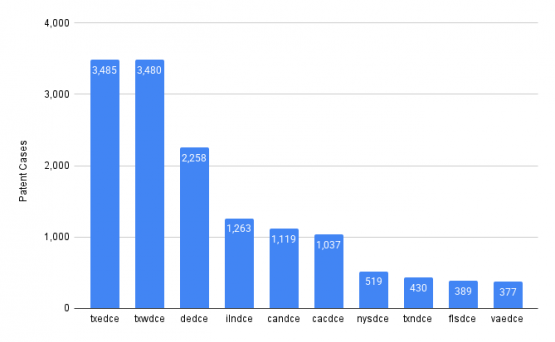
Patexia Insight 256: Patent Litigation Remains Concentrated in Key U.S. District Courts
U.S. District Court patent litigation continues to be one of the most consequential and data-rich arenas in intellectual property enforcement. Between July 1, 2020, and June 30, 2025, 18,352 patent cases were filed across federal courts, involving tens of…

Litigation Finance Tax Dropped From Trump S Big Beautiful Bill
In a major development for the billion dollar litigation finance industry, a tax provision targeting litigation funders has been removed from President Trump’s sweeping tax and spending legislation, dubbed the “Big, Beautiful Bill”,…