
AIA: False marking and false innovation
Contributed by techblorg.com. Originally published on Patexia; republished here as part of the LexDana archive.
US patent law has a number of messes and one of the purposes of the America Invents Act is to do some housecleaning. The area of false marking is an excellent example -- not simply of a mess that needs to be cleaned up, but also of how the AIA may ultimately be making an even bigger mess of things.
Any other use is known as “false marking” and it applies whether you’re simply making up the patent completely, referring to an actual patent that you don’t have the right to use, or if the patent was once applicable but has since expired or been invalidated. This also applies when you use the classic “patent applied for” or “patent pending” when there isn’t really any application filed or pending.
One thing the AIA has done was eliminate the “expired” offense. While it may still be misleading to stamp your product with a patent number from 1912, it’s not going to lead to legal trouble. This is a win for both the cleaner patent house and for deceptive marketing in general.
The only debatable language in section 292 is “for the purpose of deceiving the public," which makes up the bulk of arguments in false marking cases. If the defense can prove beyond a reasonable doubt that a product was truly stamped in error or in good faith (and that these actions have ceased), then they have a fair shot at avoiding the penalty.
What is the penalty, you ask? “Not more than $500 for every such offense.” Well, that presents a problem. Is the actual offense the false marking of a line of products -- or is each stamped product an offense in and of itself?
Obviously, this distinction could mean the difference between a $500 penalty and a multi-billion dollar penalty. The decision In the 2009 The Forest Group, Inc. v. Bon Tool Co. case weighed the precedents and came down in favor of ‘penalty per article’ (or, potentially, per a certain unit of time which, when added up, represents the duration of production -- but let’s not confuse the issue).
Enforcing 292 was something else entirely; the government simply didn’t have the resources to track down and penalize the undoubtedly countless cases of false marking that slipped through the cracks. Luckily, subsection (b) allowed them to crowd-source it: “Any person may sue for the penalty, in which event one-half shall go to the person suing and the other to the use of the United States.”
This is known as a “qui tam” action and it’s a cornerstone of such legal areas as Lincoln Law whistleblowing and undersea treasures off the coast of Florida. When it comes to false marking, however, it’s most appealing to opportunistic third-party litigators -- especially considering the per article penalty potential.
After Forest v Bon Ton, the courts experienced “an avalanche” of false marking suits that lasted until the beginning of this year. The breaking point was when qui tam was found to be fundamentally unconstitutional in the case of Unique Product Solutions v HyGrade Valve (2011). No word yet on how this affects sunken treasure hunters (or, more chillingly, government whistleblowers), but it’s largely a moot point now, thanks to the AIA.
You see, the AIA has returned full responsibility to the government for filing false marking suits. Private entities that have been truly harmed in some way by false marking are still encouraged to sue, provided that they can actually prove that the fraudulent marking hurt their business.
Those vigilante ambulance-chasers were at least bringing to light unethical practices and helping to bring in some revenue that didn’t have to come from the taxpayers. Although, to be fair, the revenue aspect may be an equitable trade-off considering just how much the additional court time was costing us.
All-in-all, this upholds the theory that one of the most effective ways to fight crime is to get rid of some pesky laws. Or, to return to the original metaphor, I could probably have a much cleaner house if I finally got around to throwing out one or two of those messy retaining walls.
More insights
Does the Uspto Issue Secret Patents on Aerospace Innovations
Written by : Tom Cowan Key Takeaways : Despite periodic mentions by aerospace innovators of “secret patents,” this author is not aware of any evidence of such patents. There may be confusion with “Secrecy Orders,” which apply to…
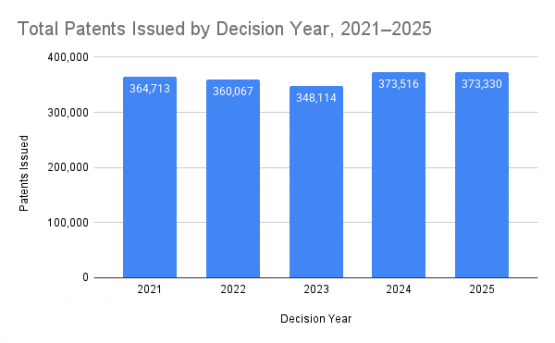
Patexia Patent Insight 20: Patent Issuance Levels Hold Steady Through 2025
Raw numbers often say more than commentary. In patent prosecution, issuance data provides one of the clearest signals of how much innovative activity is actually making its way through the system. Unlike filings, which can reflect short-term strategy…
Life Science Considerations on the Uspto S New Guidelines for Ai Assisted Inventorship
Written by : Robert J. Hilton, Ph.D. and Susan M. Janicki, Ph.D. On November 26, 2025, the United States Patent and Trademark Office (USPTO) issued revised guidelines for determining inventorship of AI-assisted inventions, [1] which is a significant…